
Talking Baseball: Vol. 33
It has been so long since the Pittsburgh Pirates have given their fans (and the media covering them) a competitive baseball team that I am not sure anybody quite knows what to do with it. Or how to talk about it. Or what competitive baseball teams do when they are in a playoff race in the middle of July.
Just look at the discourse that has been surrounding the team during the All-Star Break this past week as an example. With no games being played, the trade deadline looming in just a couple of weeks, and the Pirates having clear needs, everybody has been trying their hand at playing armchair general manager.
The talk radio circuit and social media has been trying to push the possibility of trading Oneil Cruz or Brandon Lowe for pitching help, specifically in the bullpen.
Or at the very least asking the question of whether or not such a move would make sense.
The thinking is simple and usually involves one or more of these talking points:
The Pirates have the best offense in baseball at the All-Star break (most runs scored, second in OPS) and have managed to keep scoring runs with Cruz, Spencer Horwitz, Konnor Griffin and Endy Rodriguez sidelined.
Jake Mangum is on a heater and can handle center field duty.
Esmerlyn Valdez is a rising star. He is your new middle-of-the-order power bat.
You have to give something to get something.
Tyler Callihan or the newly acquired Jacob Gonzalez can handle second base, and you are probably going to lose Lowe after the season in free agency anyway. Hey, the offense is good enough, let’s try to get some help elsewhere.
All of this is backwards thinking.
This is the type of thinking that keeps your team mediocre and incapable of taking the next step. This type of thinking is how the Pirates stay … well … the Pirates.
I want to preface this by saying I do not believe the Pirates, at this point, are thinking this way. My guess (or hope) is that they are looking to complement the roster and give it the help it needs by trading from the farm system and not moving key contributors from the Major League roster. I want to believe they are doing that because it is how contending teams operate, and how playoff hopeful teams operate.
It is absolutely nonsensical to think about trading an All-Star level center fielder or second baseman for bullpen help during the season.
Or any kind of help.
Contending teams don’t trade key contributors from its Major League roster for help during the season.
Let’s say that again, in bold letters, just to drive the point home.
Contending teams don’t trade key contributors from its Major League roster for help during the season.
The idea of moving a Cruz or Lowe assumes an awful lot of things going forward.
It assumes that Esmerlyn Valdez is going to keep hitting like he is prime-era Barry Bonds. As much as I like him and his upside, he is not going to keep hitting like he is prime-era Barry Bonds.
It assumes that Jake Mangum is going to maintain this heater that he has been on and keep hitting like he’s Ichiro. He is not going to do that. His best role and value is as a fourth outfielder. That is what he would be on a contending team. This is what he should be on a contending team.
It assumes nobody at any point pulls a hamstring, breaks a bone, or gets injured in some other way over the next few moths. Players have been getting injured all season (including right now). You are almost certainly going to need that depth. Even if it is not for an injury, but due to a slump or simple regression.
You also should not be looking at the trade deadline as a way to balance out the roster by shifting value and contributions from one part of the team to another part of the team. You are not going to get better by taking two wins from the lineup so you can add two wins to the bullpen. That leaves you with the same number of wins, just with a different roster alignment. The bullpen might hold on to an additional lead or two, but it might not have as many leads to hold on to. The goal should be to keep the wins and value in the lineup, and add to it by adding and wins and value to the bullpen. You do that by trading from your farm system.
That is how playoff teams operate.
I do not want Oneil Cruz or a top relief pitcher.
I want Oneil Cruz AND a top relief pitcher.
The Pirates have finally assembled a lineup and offense that is worthy of a contending team, and has enough pieces to be a serious playoff team, and I am not in any hurry to take away from that.
The table below shows every playoff team from 2025 and how many hitters (minimum 200 plate appearances) had an OPS+ of 100 or better, and how many had an OPS+ of 120 or better.
(100 being a league average hitter, and 120 being a well above average hitter)
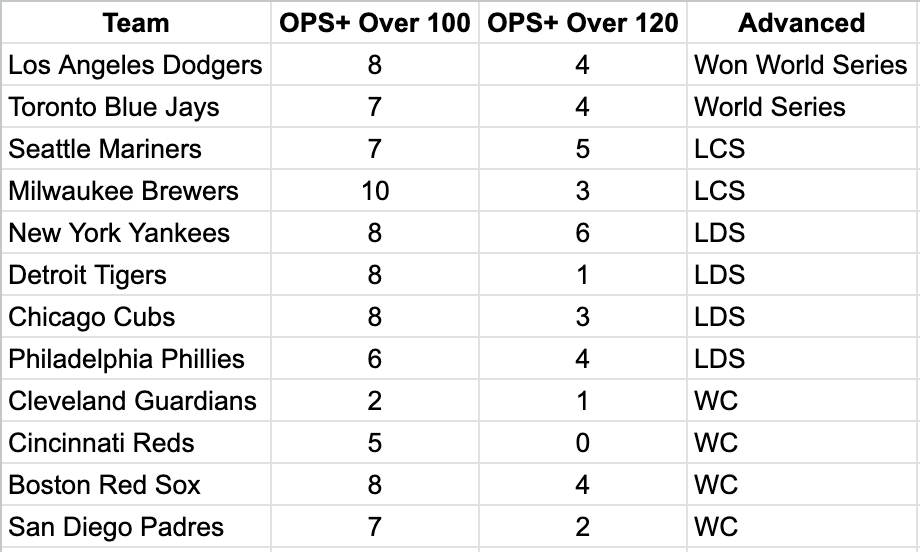
The 2025 Pirates had one hitter (Spencer Horwitz) over 100, and zero over 120.
As of publication on Friday, as the second half of the season is about to begin, the 2026 Pirates have eight players with an OPS+ of 100 or better and four with an OPS+ of 120 or better.
That is what the serious World Series contenders (and World Series teams) did a year ago.
Esmerlyn Valdez (105 plate appearances with a 189 OPS+), Endy Rodriguez (122 plate appearances with a 135 OPS+) and Tyler Callihan (89 plate appearances with a 111 OPS+) do not yet qualify for that table and do not have 200 plate appearances yet. If they did, they would give the Pirates 11 players over 100 and six over 120.
Well above even the best teams in baseball.
That still does not entice me to move anybody from there. Mostly because there is a chance for some regression with some of these guys (Valdez and Mangum almost certainly; perhaps Nick Gonzales and Endy Rodriguez) and, again, the potential for injury. Shortstop Konnor Griffin is one of the players that does qualify with an OPS+ over 100, but nobody knows when or if he will play again this season. Spencer Horwitz is also on that list and currently injured. You have to allow for all of that over the second half of the season. Not only how players will return, but in case somebody else gets hurt and misses time.
Keep your strength. Keep your depth. Add to it.
I would be willing to trade top prospect Seth Hernandez in the right deal. It would have to be for a proven front-line starter (I am looking at you, Joe Ryan), but I would listen.
I would have outfielder Edward Florentino available, and I think I would be willing to move him for a top-tier reliever.
Everybody after them in the farm system is fair game for even adequate bullpen help.
You have an elite offense. You have maybe two years of Paul Skenes before you trade him. Your window should be open right now. Move some prospects to add to the roster. Do not take away from the roster to try and fix other areas. It is not what winning teams do. There is a reason for it.
Everything I just typed here about the Pirates? It also applies to the Washington Nationals, who are a near identical match to what the Pirates are.
Speaking of the Pirates: Baseball road trip next week. Pirates vs. New York Yankees at Yankee Stadium on Monday night and Tuesday night.
Is Mason Miller … overvalued?
Speaking of bullpen help, the guy that everybody is losing their shit over right now is San Diego Padres closer Mason Miller.
He is the best relief pitcher in baseball.
I think if you really tried you could probably put together a Cy Young argument for him, or at least put him into the discussion as a No. 2 or 3 behind Jacob Misiorowski and Cristopher Sanchez.
From a Pirates perspective, he is from Pittsburgh and Pittsburgh people love local guys.
There is speculation the Padres might be listening on trade offers for him.
All of these things put together have helped jumpstart the discussion of whether or not the Pirates should trade Oneil Cruz or Seth Hernandez for him.
As much as I would love to have him on the Pirates, and for as much as the Pirates need bullpen help, I don’t think I would do either of those moves. Actually, I flat out would not do either of those moves. Even further, I would argue this entire discussion, hypothetical as it might be, is a pretty good sign that Miller, as great and dominant as he is, might be one of the most overvalued players in baseball.
Especially in relation to the Pirates.
The Pirates do not just need one guy to get three outs in the backend of the bullpen.
They probably need two guys to get six or seven outs, and they might even need another starting pitcher.
Miller alone is not going to push the Pirates over the hump. He might get them closer. He would definitely help them. But he’s not enough. It makes little sense for the Pirates to deal their most valuable trade chip (Hernandez) or a potential All-Star hitter, for one that one guy when they would still need more help along with that.
Also ask yourself this: Why would the Padres be willing to trade Miller? Or even listen on the idea of trading him?
They traded for him literally one year ago, sending a top-three prospect in all of baseball (shortstop Leo De Vries), along with three other solid prospects, to the Athletics for him.
In his one year he has been everything that the Padres could have wanted him to be. He has probably been even better and more dominant. He is still YEARS away from free agency and is under team control for the foreseeable future. The Padres, even with a down year this season, are still constructed to be a potential playoff team within this window over the next few years. He should be a player they want.
So why would they move him? Why would they even consider moving him? Why would they even pick up the phone when somebody calls about him?
Well, that is simple: Because they know he is potentially overvalued, and they know they can potentially rip a team off by moving him. His perceived value may have started to exceed his actual on-field value. Do not be the team that gets ripped off.
If I had a high level of confidence that the Pirates were one closer away from winning the World Series this season you might be able to convince me that it would be worth losing the trade to get Miller and sell my farm system for him. I do not have that level of confidence they are one Mason Miller away.
Trade some second-and third-tier prospects for a couple of good bullpen arms. It will work out better. You will get the depth you need without sacrificing your best assets, leaving them for bigger trades or an ability to get more value out of them as players.
The home run derby rocked, even if everything else about the All-Star week did not
Major League Baseball made another change to its home run derby format this season, ditching the timer and going with a swing-based approach. It was closer to what the derby was in its early days when players received 10 outs, and every swing that was not a home run was simply an out.
It was slower-paced, but it allowed for you to marvel at the home runs and allowed you to actually watch guys sock a bunch of dingers.
The only year this really failed was the 1990 game at Wrigley Field when the contestants, including a likely roided-up Bash Brother duo of Mark McGwire and Jose Canseco, combined to hit just six home runs. As a group. In the entire event.
(The wind was blowing in to Wrigley that day, for what it is worth.)
It made rounds like the one McGwire had in Colorado, or the one Josh Hamilton had in Yankee Stadium, more impressive by the numbers. Double-digit home runs when you only have 10 non-home runs swings means a lot more than the rounds we saw in recent formats.
The format that preceded this year’s was strictly based on time.You had an allotted time period in each round to get in as many swings as you could. There was no punishment for a non-home run beyond the loss of a few seconds on the clock.
In theory, it could have worked. More swings, means more dingers. And that’s why everybody is here. To see dingers. But it actually produced a horrendous viewer experience even with the additional dingers. The pitches and swings happened so fast that you never really had a chance to watch where the home runs landed or the distance they traveled. It also resulted in guys absolutely exhausting themselves in the first round by swinging 50 or 60 times with maximum effort, and then running out of steam in the later rounds.
Sure, there were more home runs, but you didn’t get to enjoy them or marvel at them.
This year’s format gave players a set number of swings, whether they were a home run or not. You could extend your round by continuing to hit home runs on your last swing, which is what St. Louis Cardinals outfielder Jordan Walker did in the championship round to complete a comeback to narrowly beat out hometown favorite Kyle Schwarber.
There were not as many home runs as the previous years, but I enjoyed them more, I actually saw more of them, it was somehow faster, and it produced about as dramatic of a finish as such an exhibition event could.
It rocked.
Unfortunately, everything else about the broadcast, and the All-Star game in general, sucked.
Major sporting events on streaming services? Sucks.
The announcers and broadcast itself? Generally sucked. Too many different camera angles. Overproduced. Too many behind the scenes people trying to make the broadcast an artsy production instead of just giving us what we want to see: Dudes socking dingers.
Then there was the game itself on Tuesday.
No matter what anybody tries, there is simply no way you are going to fix All-Star games. In any sport. The players don’t really want to be there. Everybody knows it is meaningless. You are not going to get any sort of passion or excitement no matter how much you try to force it.
Then there is the broadcast itself.
Not to sound like an old man here, but an 8:30 local time first pitch is unnecessary. Stopping the game three or four times for on-field concerts, including a really bizarre sentimental bomb featuring a 20-year-old video of Ray Charles, while a bunch of kids ride bikes out on to the field, is unnecessary. It was not only unnecessary, it was just really freaking weird.
The NFL has pretty much all but ditched the Pro Bowl. The NHL and NBA are trying every format under the sun to build interest in their games, with the NHL getting closer and closer to flat-out ditching it as well as they keep adding international tournaments that would replace the game.
I am not saying baseball needs to ditch the All-Star game. But I think we need to ditch the idea of trying to make it better.
You are not.
It is what it is and there is nothing that changes that. Just let it stand as that and stop worrying about how to fix it.