
Talking Baseball: Vol. 29
We are talking Pittsburgh as a baseball town, going to a game, and the misunderstanding of the Statcast era.
Paul Skenes latest start generated some buzz around Pittsburgh this week, and it was not necessarily because he took another potential no-hitter deep into a game.
At this point, that is just becoming the expectation when he is on the mound.
It also wasn’t because that start, an eight-inning gem where he allowed zero runs, walked none and struck out 10, lowered his ERA for the season (and for his career) back down to under 2.00, which is just a comically absurd number.
It was because the Pirates, owners of a winning record in mid-May, playing on one of the 10 perfect spring days the city of Pittsburgh sees in a given year, and with the best pitcher in baseball on the mound, had just 13,516 people in the stadium.
There is no way to sugarcoat it: That is a bad number given the aforementioned circumstances.
It is also a bad number when you consider the Pirates, owners of a 24-20 record entering play this weekend, are 28th out of 30 teams in average attendance, ahead of only the Miami Marlins and a team playing in a literal Triple-A stadium (the vagabond Athletics).
It is, at the very least, something worth noting, and long-time Pittsburgh sports columnist Bob Smizik made sure to note it, touching off a week-long discussion as to whether or not Pittsburgh is a good baseball town.
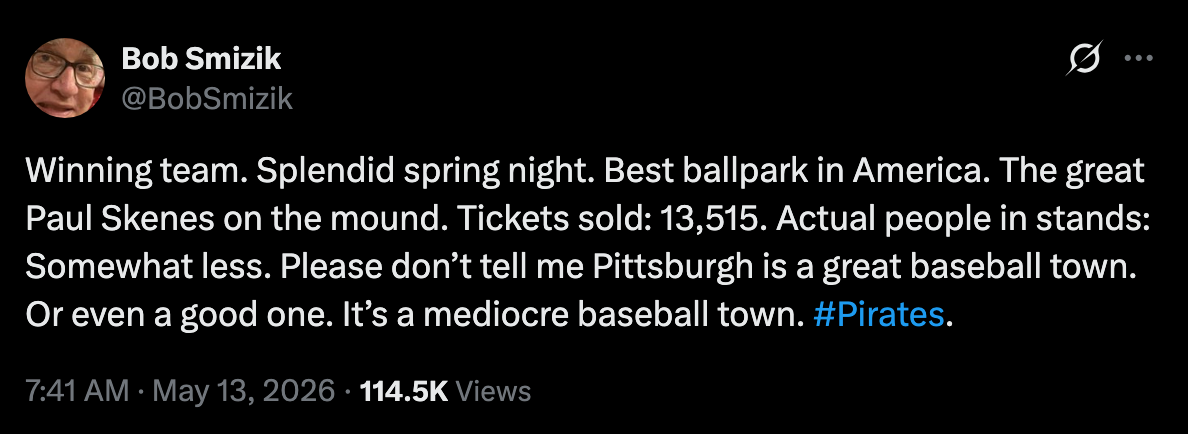
If nothing else, it shows that Smizik can still bring the heat even though he hasn’t been a columnist or prominently displayed in the Pittsburgh media scene in … what … 15 years?
He got people talking, and that was always his ultimate job.
There are a lot of ideas and theories as to why the Pirates do not draw or are not drawing this season. A lot of the reasons (and excuses) are the same type of thing you hear at this time of year, every year.
It is a weeknight and kids are still in school. Attendance will pick up in the summer.
It was a bad opponent.
It is too expensive to go to games.
I don’t want to give Bob Nutting my money until he commits to winning.
So on, and so on.
There is some validity to a lot of the arguments that get made, but it ultimately comes down the simplest explanation: The franchise has made three playoff appearances, winning just three playoff games, in the past 33 years.
That sucks.
In the 47 years since its last pennant and World Series title, it has not won a single playoff series and has produced just 11 winning seasons, while also consistently being one of the lowest-spending teams in baseball.
That also sucks.
It is going to take more than 44 games of slightly above .500 baseball, the additions of Brandon Lowe and Ryan O’Hearn, and one market-value contract extension (Konnor Griffin) to erase the level of skepticism, frustration and, quite simply, anger, that has been built over five decades of bad to mediocre baseball.
Pittsburgh showed in 2013, 2014, 2015 it will support a competitive team. By 2015, the third-year of that three-year run of playoff appearances, they were averaging over 30,000 fans per game.
Then, instead of building on that run and a 98-win season, they pulled the rug out from under everybody and reverted back to the same old Pirates.
People will ignore school nights, ticket prices, and bad opponents if they believe the team is going to win, or gives them reason to believe they are going to win.
Maybe that makes Pittsburgh a fair weather or front-running town, but most cities tend to be, especially when the team in question has been a perpetual loser.
It is especially true in mid-market and small-market cities that do not have a huge population base to draw from.
It is one thing for a bad New York Mets team to average 35,000 people when they are pulling from a population of eight million (and a metro area of 19-20 million). Just based on the volume of population you’re going to get a percentage of people that are just going to say, “hey, who cares if the Mets suck, I just want to go.”
It’s something else for a city of 310,000 (and a metro area of two million) to be able to pull that off.
You better win, and you better give people reason to give a damn.
For decade the Pirates have done neither.
If the Pirates keep winning into the summer and attendance is still looking the way it has so far, and especially in Paul Skenes starts, then we can really start having this discussion.
What you’re seeing now, in my view, is people simply not buying in to what the Pirates are selling just yet.
I can’t really blame them if they haven’t. At least not yet.
For years the people that went to Pirates games through all of the losing were consistently mocked for being suckers for giving their money to a team that didn’t care to win and wasn’t worthy of support.
Now they’re being mocked for … wanting to see more before they buy in.
There is a subplot to all of this that I also want to dive into, and it is, in fact, the ticket prices, and Pittsburgh fans are sort of in a tough spot here.
At least compared to a lot of other cities.
That doesn’t mean it’s impossible to do this for a price that doesn’t cost you an arm and a leg.
While there can be really cheap ticket prices available on the second-hand market for a lot of games, the tickets from the Pirates themselves are on the higher side.
I go to a lot of baseball games.
I go to a lot of baseball games in Pittsburgh and in other cities.
I have gone to a lot of baseball games in bigger cities, with better teams, and paid far less for a ticket than you sometimes can at Pirates games.
I have sat behind home plate at Citi Field for $10.
I have sat in the bleachers in Yankee Stadium for $15.
I have sat in the club level at Camden Yards for $25.
I sat in the front row in Nationals Park for $18 one night.
You’re not consistently able to do that at a Pirates game right now, even on the nights with small crowds.
On any given night when you go through Stubhub or SeatGeek, most stadiums, outside of maybe Dodger Stadium and Philadelphia (which are always shockingly expensive), have get-in-the-door tickets far cheaper than your average Pirates games.
My theory on this isn’t just the reality that face-value Pirates tickets are on the higher side, even for the “cheap seats,” but also because the Pirates simply do not have the season-ticket base a lot of other teams have, thus they do not have people looking to dump seats for random Tuesday night games.
Follow me here: A Major League Baseball season is 162 games. That is 81 games at home. If you have full season tickets, or even a half-season package, you are not going to attend every single one of those games. Most people won’t, anyway. There are going to be games where you just say, “I can’t make it tonight, nobody wants it, I’m just going to try and get SOMETHING” for it.
When I go to other cities I never buy tickets from the team. It is always the second-hand ticket market, and it almost always gets me good seats for usually far below face value.
Those are typically season-ticket holders selling those seats.
What does five decades of mediocrity and poor spending do? It crushes your season-ticket base. When you have a minuscule season-ticket base, you’re not getting people looking to off-load cheap seats. When you’re not getting people to off-load cheap seats, you typically have to pay closer to face value which can be more expensive.
That’s not necessarily a winning formula at the box office for a team that, as we established above, is more often than not … bad.
Hey, I made my decision in life to be a freelance sports writer. I am poor. I get it. Times are tough out there. I am sympathetic to the cost of doing shit and how expensive living is. It sucks.
But there is one thing that gets brought up in this argument that I do sometimes have a problem with, and it’s when people start talking about the price of going to a game and start adding in all of the other costs that you don’t necessarily need or don’t need to pay.
You can cut a lot of costs off of this with a little planning, a little thought, and a little creativity if you just want to see a baseball game in person.
You don’t HAVE to eat your entire meal for the night at the stadium.
You don’t HAVE to buy four beers and four Pepsi’s.
You don’t HAVE to park in the stadium parking lots right next to the place and pay $35 for the convenience of that location.
PNC Park literally lets you take in your own food. Most stadiums do.
I walked in behind a family of four a couple of weeks ago that took an entire, big ass pizza in to eat during the game with their own unopened bottles of water. Honestly, it looked fun as hell. It was also probably better than anything they would have bought inside.
You can take in your own snacks. You can take in water bottles.
There’s a guy on the city side of the Roberto Clemente Bridge selling $1 waters and $2 bags of peanuts before every game.
I’ve had people tell me how that isn’t a fun experience for kids or families to not get every treat that is walked in front of them. Buddy, I was a kid once in a working class family. I went to games where my parents brought all of our shit with us and didn’t spend anything at the stadium or buy me anything inside. And let me tell you … it never once ruined my experience. I was just happy to be at a baseball game. Because that’s what was important to me.
There are several parking garages downtown within a 10-15 minute walk of the stadium that charge you a $6 flat rate on evenings and weekends. If you don’t want to make that walk, or can’t make that walk, there are several of those garages in close proximity to “T” Stations that will take you right to the stadium, all of which are within the city’s free zone.
You can trim triple digit dollar amounts off your cost of going to a game by doing some of these things.
When I bring these facts up to people I usually get told “that’s too much work” or “but I don’t want to do that.”
Well … that’s a different discussion.
Some people pay extra for the pre-cut fruit at the grocery store. Others will pay less for the whole fruit and cut it themselves. Do you want to pay for convenience or do you want to find a cheaper way? There is no wrong answer to that question, it’s all about what is more important to you.
But if you just want to see a baseball game and if THAT is the most important thing … it IS doable. Or at least a little more doable than the initial perception.
At the end of the day, none of these things matter if the team keeps winning, or if they add another bat, or if they eventually do the unthinkable and sign Skenes.
No amount of costs, parking, or opponents will stop people from going at that point.
Just win. Just keep your good players. Just spend some money on the roster.
I generally like Ken Rosenthal and think he’s consistently been one of the better baseball writers of our time. But his article this week on Cincinnati Reds star Elly De La Cruz improving because he is not “chasing metrics” is one of the weirder stories I’ve read in quite some time.
I’ve read it multiple times just to see if I am missing something, and it still comes back reading like an article where he went in with a premise, didn’t find the answers he was looking for, but still decided to push forward with it anyway.
In the end it just seems like catnip for the people that think metrics like exit velocity and launch angle are stupid and unnecessary and shouldn’t be used to evaluate players or how good they are.
It’s literally the angle he pushes just a few paragraphs in:
No longer simply a Statcast monster, De La Cruz is evolving into one of the sport’s best all-around players. Rather than just chase metrics, he’s chasing results.
This presumes that De La Cruz was simply trying to produce the hardest exit velocities and register the highest reading on radar guns on his throws across the infield without actually caring about the results they produce on the scoreboard. And with all due respect to Rosenthal, or anybody that is a critic of the Statcast era, I am having a hard time buying into the notion that there are players that are simply focused on that.
At least not in the sense that it is portrayed.
Hitting the ball hard is not a new concept in baseball. It’s as old as the game itself, and one of the most basic elements of the sport when you step into the batter’s box. A harder hit ball is more likely to travel further and become a hit than a weaker hit ball.
A harder thrown ball is going to allow you to get more outs than a weaker thrown ball. It’s why arm-strength is a prominent part of being able to play shortstop, third base or catcher.
Where the premise of the whole thing falls apart is in the very next paragraph where Rosenthal acknowledges the reality of De La Cruz’s season: He still hits the ball and throws the ball harder than anybody.
De La Cruz, who declined comment for this story, still hits the ball harder and throws it harder than just about any other position player. His maximum exit velocity of 116.3 mph is in the top one percent of the league. His average exit velocity of 94 mph is in the top four percent. He also has four of the top five fastest-tracked throws by an infielder since 2015, including one at 101 mph.
And he does. Not only does he still do that, but he is hitting the ball harder than even HE ever has in the Major Leagues. And by a pretty significant margin, as well.
He’s absolutely annihilating the ball, and yes, that is contributing to his better results.
There is an interesting story to be told about De La Cruz, his development and his improvement across the board.
Framing it as him not chasing Statcast metrics, or as a Statcast story in general, isn’t it.
And I wonder if that contributed to De La Cruz not wanting to be interviewed for the article (because he didn’t want to be, and he wasn’t).
Simply hitting the ball hard and throwing the ball hard doesn’t guarantee good results.
But it certainly helps produce them.
De La Cruz is always going to do those two things because he’s a 6-6, 200-pound cyborg that was constructed out of the best physical tools you could ever want a baseball player to have. That’s going to help him hit harder, throw harder, run faster and be better than a lot of players. That doesn’t mean he was ever chasing Statcast metrics. And it doesn’t mean he stopped focusing on them to get better.
He’s just getting better. Because that’s what happens with talented players that gain more experience and put the work in.
That’s the angle. That’s the story of Elly De La Cruz.
Great article as always. You have a really good writing style - conversational and easy to read. Glad to be a part of your audience.